
How to Build a Conformant C2PA Generator Product
A guide to conformance, certificates, and all the pieces you need to get your Generator Product running in production.
If you are building your own Generator Product, there are several pieces that you need to get right for your Content Credentials to be shown as trusted. This involves going through the C2PA Conformance Program, procuring certificates, configuring manifests, adding timestamps and OCSP responses, and more. This is a practical guide on how to do so.
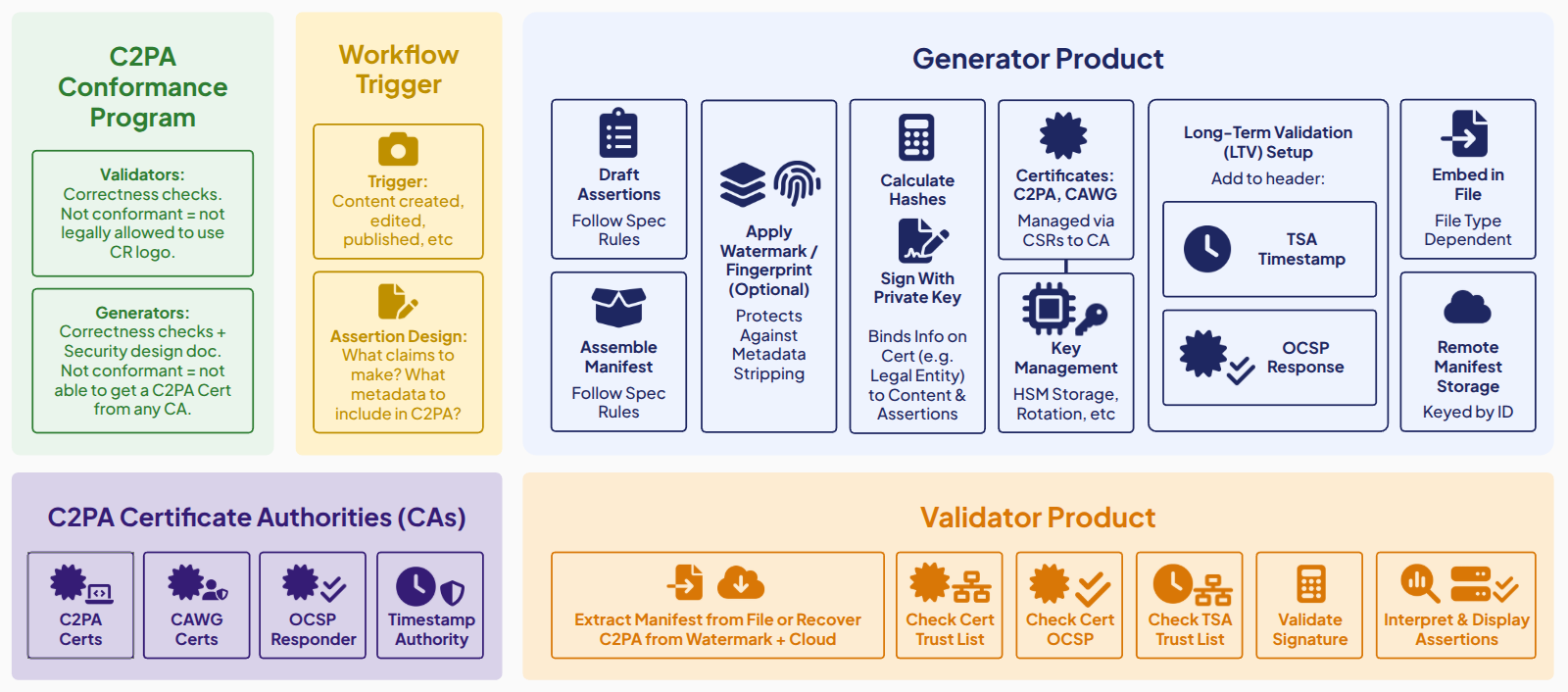
#Architecture
The first step is to design your Generator Product. Here are some decisions you need to make:
| Decision | Option | Notes |
|---|---|---|
| Build Approach | Build Your Own | if you are familiar with content provenance or have specific needs |
| Managed | if you want a turnkey solution to C2PA to save on time and personnel commitments | |
| Assurance Level | Level 1 | to get in-house C2PA deployed in production |
| Level 2 | to demonstrate hardware-level trust | |
| Deployment | Backend | keys + processing are in server |
| Edge | keys + processing are in client | |
| Distributed | keys in server, processing in client | |
| Identity | C2PA Only | only need hardware/software provenance |
| CAWG Identity | want individual/organization attribution |
If you are not sure, Trufo offers two complimentary consultations.
For Level 2, you will need to demonstrate hardware key security, and this involves working with the CA to submit the proper attestation documents when requesting certificates.
Once you have decided on what to build, you need to pass through the C2PA Conformance Program, which involves putting together a security architecture document and providing evidence of functionality via samples. The c2pa-rs library is a good starting point (though it is often insufficient on its own). You will need to implement the sections of the C2PA specifications that are relevant to you. The specifications are long (hundreds of pages of material), so be prepared to sink some time into understanding how C2PA works. For sample generation, we recommend using a test certificate. Once your application is submitted, the process can take anywhere between 1 week and 3 months.
#Certificates
Once you have obtained approval, you will need to find a CA to purchase a certificate. This CA needs to be on the C2PA Trust List. Popular CAs include Trufo, DigiCert, and SSL.com. You will need to pass Organization Validation (OV) and Product Validation (PV). The former certifies your legal entity, and the latter certifies your CPL record. This usually takes a few days. Then, you need to generate your secure key (ideally in a FIPS 140-3 Level 2+ HSM or equivalent) and make a CSR to the CA to obtain your certificate. The exact process differs by CA, but for most, a well-designed API will be critical for a smoothly-running production C2PA system.
Trufo’s certificate procurement process is documented publicly at trufo-py.
You will also need timestamping and OCSP stapling. These are required in order for Content Credentials to remain valid after the certificate expires; after all, unlike HTTPS where network traffic is received immediately after it is signed, oftentimes content is consumed many years after it is created.
- There are a number of C2PA Timestamping Authorities (TSAs) who provide timestamping services, including Trufo, DigiCert, and SSL.com. For free timestamping (not C2PA-trusted), Trufo and DigiCert provide endpoints.
- OCSP stapling needs to be implemented in your C2PA manifest construction. The C2PA CAs will provide OCSP response endpoints for you to query (and cache) to execute OCSP stapling.
Lastly, if you want individual or organization identity, you will need a CAWG certificate. Currently, the CAWG trust model is still in an interim phase. There are a few trust providers you can use: Trufo, Pixelstream (ICA only), SSL.com (S/MIME only). We expect that CAWG will enter a mature state by the end of the year.
#Production
Once you have everything set up, you will need to productionize the Generator Product. The C2PA specifications are still evolving (though as of late 2026 it is now quite stable), and you may want to add more features. When this happens, you will need to go through the above process again.
One aspect of C2PA that will likely become much more relevant in the near future is soft bindings, a.k.a. watermarks. The EU AI Act heavily encourages these (though zero-bit watermarks also work), and new legislation in the US is also near at hand. Providers of soft-binding solutions for C2PA include Trufo (image, audio, video), Imatag (image, video), and Digimarc (image, audio, video).
#Managed C2PA
Putting all this together requires a team of engineers. There are also vendors that provide C2PA signing services, some targeting individuals such as ProofMode with their camera app and others targeting enterprise such as Trufo with their API/SDK suite.
For a simple Level 1 Generator Product that signs 1 million images a year with no watermarks, the estimated costs are:
| Method | Cost ($) | Cost (Eng.) | Benefits |
|---|---|---|---|
| In-House GP | $3K-$8K (mostly timestamping) | 6 dev-months + maintenance | flexible, ownership |
| Managed C2PA | $15K-$40K | 1 dev-month | enterprise support |
Designing a Generator Product? Trufo offers two complimentary consultations.
Book a Consultation